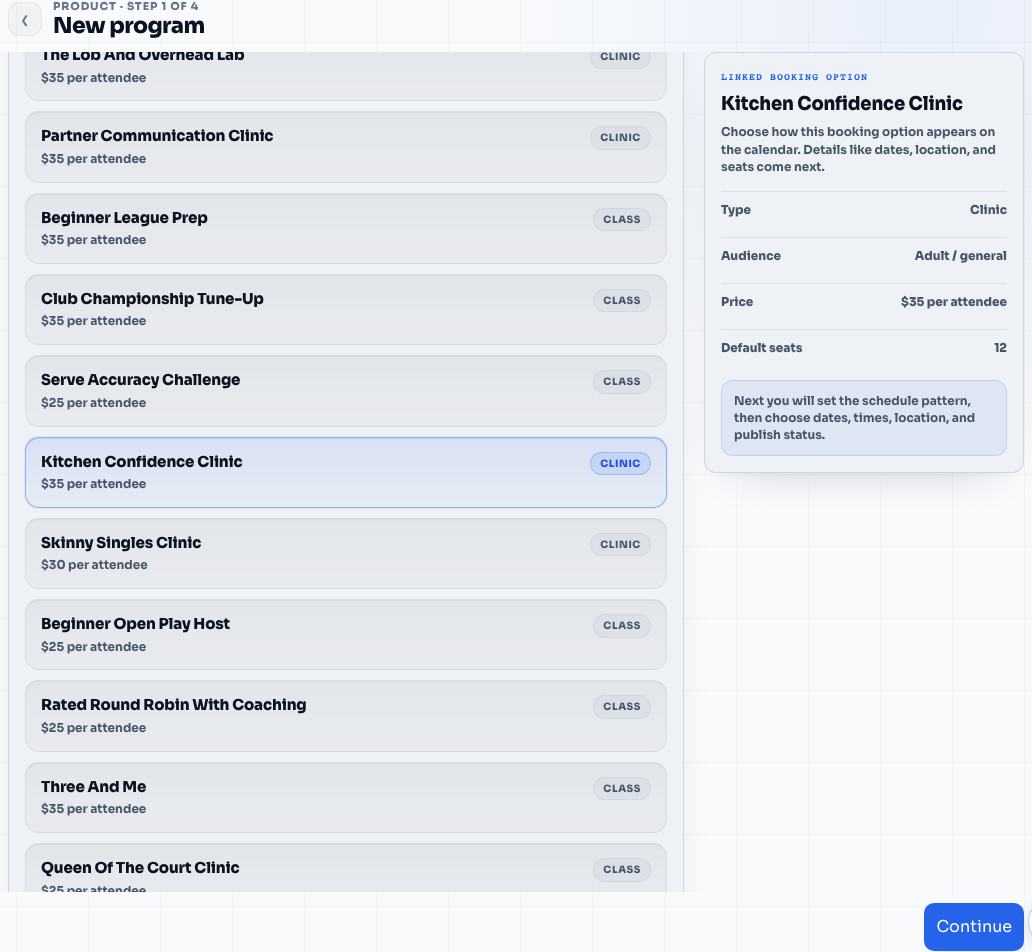


A private lesson is one person and one time. A program is a product. It has a promise, a start date, a seat count, a price, a place, and usually a parent deciding whether it is worth the Saturday. Generic schedulers only model the time, which is why coaches end up rebuilding clinics by hand, tracking seats in their heads, and answering the same three questions by text.
Elite Coach Booking models the rest of it.
Three shapes, because coaches run three things
A one time clinic. A single date, a seat count, and a page. Publish it, send the link, and stop when it fills.
A multi day camp. Consecutive days sold as one block. One registration covers Saturday, Sunday, and Monday, because a camp is not three drop in sessions that happen to be next to each other.
A recurring class or clinic series. Same day, same time, week after week. Each date is separately bookable, so a player who can only make two Tuesdays can take two Tuesdays. If your program runs on more than one day a week and should sell as a single signup, that is a weekly package.
Recurring programs publish their dates inside the booking horizon you set, from one week out to twelve. The page shows the next real dates rather than a calendar stretching into next year, and new dates roll forward as the old ones pass.
The page is part of the product
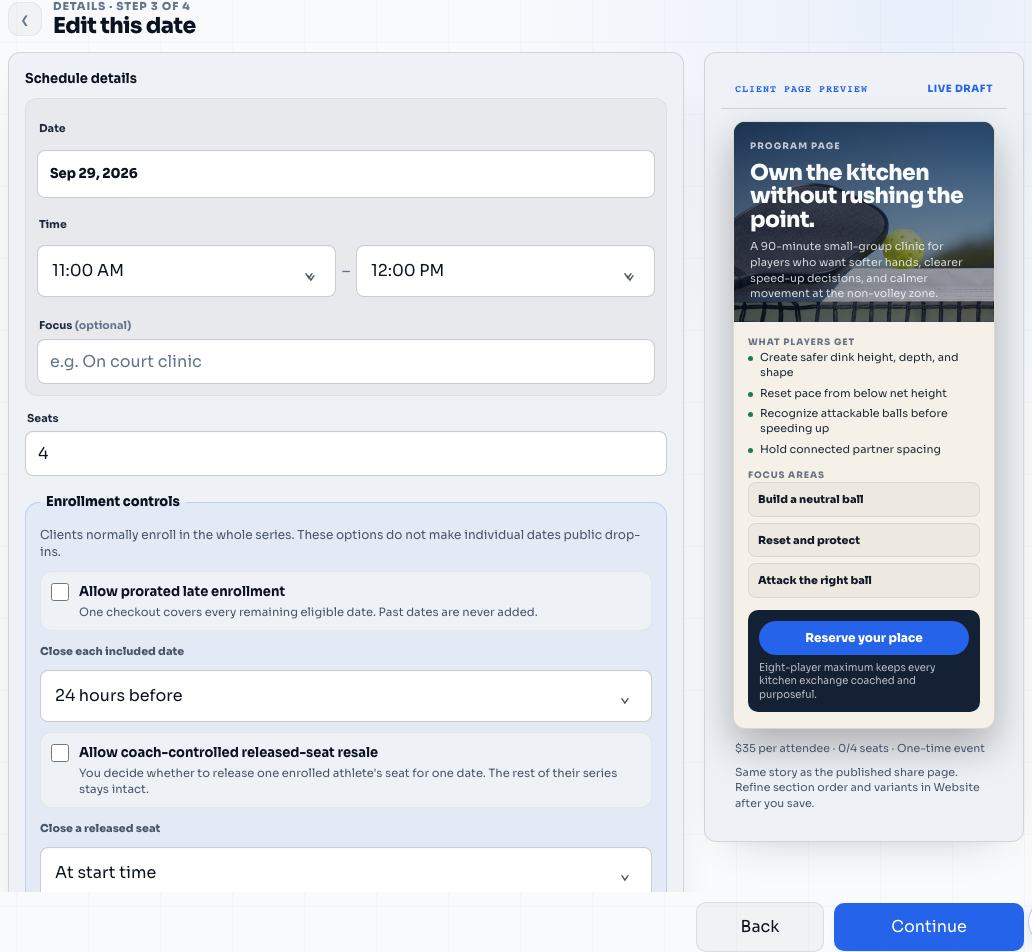
Publishing a program does two things at once. It adds the program to the programs page on your coaching website, which is a storefront players can browse, and it generates a landing page for that one program.
That landing page is not a title and a time. It holds a hero and a headline, who the program is for, what players get, the focus areas or curriculum blocks, a proof quote, your policies, the questions parents ask, a coach section, and a booking call to action. You can reorder those sections, choose an editorial or campaign layout, and lead with the schedule, the story, or the proof depending on what actually sells that program.
Every dated program page carries the things that decide a registration: the next start, the location, the seats left, the price per attendee, and a button that opens the real booking flow. When a program has a description and at least one session, its page joins your site’s sitemap, so a clinic can be found and not just forwarded.
If you would rather start from an idea than a form, AI Coach can propose a camp, prepare it for your review, and draft this page for you to edit. You confirm every step.
After people register
The roster lives on the program. You can see who is enrolled, how many seats are left, who has paid, and who still owes. You can add someone manually when a parent catches you on court, and check players in on the day. A multi day camp checks in day by day, so day two attendance is a real number rather than a memory.
Payment follows the same rules as the rest of your business. Charge in full, take a deposit and collect the balance before or at the session, or run a program for free when it is a taster. Deposits, refunds, and cancellations stay attached to the registration. See payments for how the money side works.
If you have to cancel a date, the app walks you through who is affected and what to do about their payment instead of leaving you to reconstruct it. When a program ends, you can see what it earned, how full it ran, and how many people showed up.
The program record handles the dates, seats, roster, payment state, and client communication. Use the sports coaching session plan template to plan what the coach will teach, observe, adapt, and record inside one of those sessions.
What gets easier
- A clinic goes from an idea to a link you can text in one sitting.
- Seats, price, venue, and audience live on the program, not in your head.
- The same clinic next month starts from the last one.
- Parents get a page that answers their questions before they message you.
- Group work and private lessons share one calendar, one client list, and one payout.
Why coaches care
Programs are the highest leverage hour a coach sells. Eight players in one clinic is not eight times the admin unless the software makes it that way. If setting one up takes an evening, and filling it takes a week of texts, most coaches quietly go back to private lessons.
Programs are part of Elite, at $79 a month, alongside memberships, waivers and video. Core, at $39 a month, is for coaches whose site books one-to-one lessons. Stripe’s own processing fees apply either way.
This is the part of the system that makes running group coaching feel worth it. If you mostly run clinics and camps, start with clinics and camps, or read how coaches run recurring clinics without rebuilding rosters.