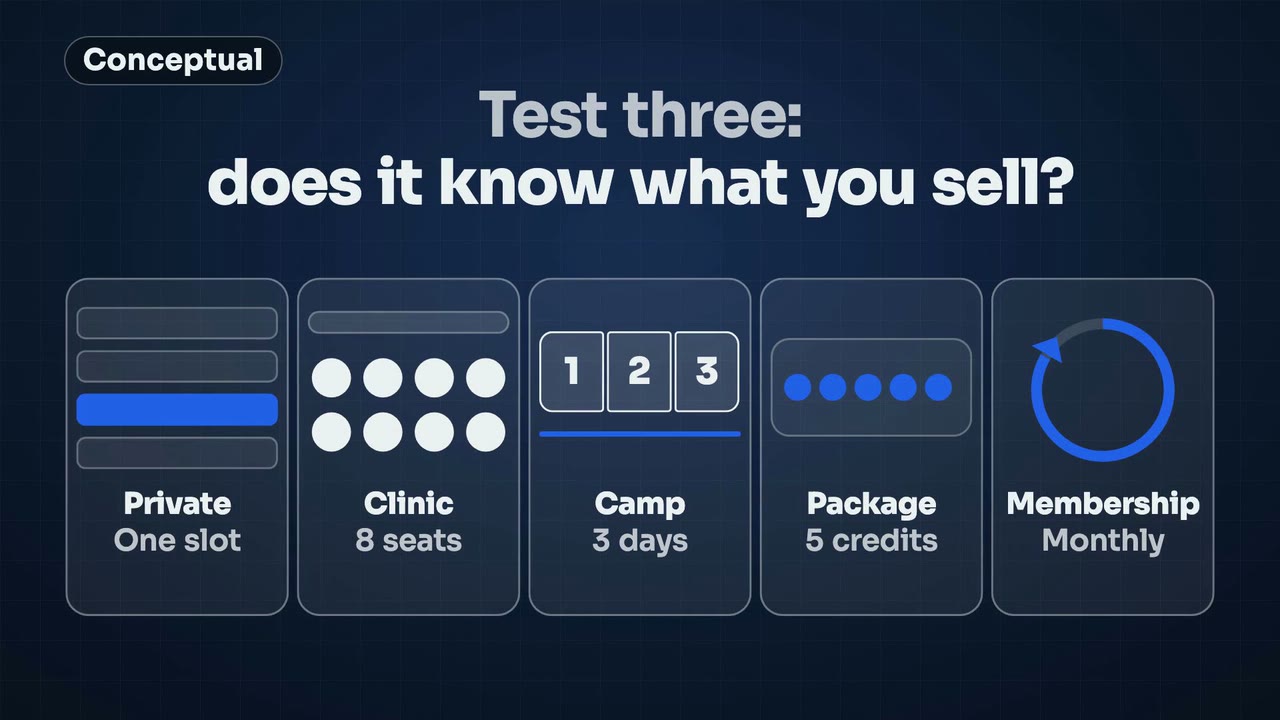
A package is a bet the client makes once. They buy six lessons, they work through them, and at some point the balance hits zero and the relationship goes quiet until somebody restarts it. That somebody is usually you, and the message is usually awkward.
A membership is a different shape. The client is not buying six lessons. They are buying the month, and then the next month, and the decision they already made is the reason they book again.
If you are moving off studio software built around class memberships, the Mindbody alternative compares it with a coach’s setup.
What a membership actually carries
A plan has a monthly price in US dollars, and one of two benefit models.
Monthly credits. The plan grants a pool of credits at the start of each paid month. Every included session has its own credit cost, so a sixty minute private can cost one credit and a clinic seat can cost two. Members spend the pool as they book.
Unlimited access. The plan grants access to everything it includes, without counting.
Then you decide what happens to a credit nobody used. It either expires at renewal or rolls into the next paid month one time. A carried credit never rolls twice, which is the rule that keeps a membership from turning into a stockpile the client cashes out months later.
What goes inside the plan
You include private lessons by duration rather than one at a time, so choosing sixty minutes covers every sixty minute private you sell. Camps, clinics, and classes go in by name, because a specific program is a specific product with a roster and a price.
Group programs follow one rule worth knowing before you sell: a camp is covered only when its entire schedule fits inside a single paid month. A camp that straddles a renewal is not half covered, and the app says so rather than discovering it at checkout.
Unlimited, without handing over your calendar
Unlimited is the plan coaches want to sell and are right to be nervous about. The pacing limits are the answer. Any plan, credit or unlimited, can cap how many bookings a member holds at once, how many they take in a day, and how many they take in a paid month.
Those limits are enforced when the booking is reserved, not audited afterwards, so a member never ends up holding a slot the plan did not entitle them to. It bounds the pace instead of the promise, which is what makes access sellable.
Publishing is the part that sells it
Publishing a membership does three things to your coaching website at once. Your site gets a membership section showing every published plan with its price, its description, and what it includes. It gets its own memberships page. And it gets a nav entry, placed after your programs, so a visitor can find plans without you sending a link.
Inside your booking widget, memberships appear as something a client can buy. When more than one of a member’s plans could cover the session they are booking, they choose which one to use rather than the app guessing.
How a member joins, and how they leave
A client enrolls through Stripe checkout embedded in your booking widget. They verify their phone by text first, so the person enrolling is reachable, and a parent can hold the payment while the membership belongs to their child.
Benefits switch on when the payment actually clears, not when the checkout window closes. A card that fails grants nothing.
After that, members manage themselves. A private link lets a member see their plan, stop future renewals, and resume them. The link is short lived on purpose, and a member who lost it verifies by text and gets a new one. You can stop or resume a member’s renewals from the coach app too, when someone asks you directly.
The money side
Membership payments run through the same Stripe connection as the rest of your bookings, under the same payout account and the same rules. On Core and Elite, Elite Coach Booking adds no fee of its own to what a member pays you. Stripe’s own processing fees apply. See payments for how the rest of the money side works.
What this pairs with
Memberships and packages solve related problems from opposite ends. A package sells a block and ends. A membership sells a month and continues. Coaches usually run both, because the client who will commit to a block is not always the client who will commit to a rhythm.
If the membership is built around group sessions, the shape of those sessions is set up in programs.
Memberships are part of Elite, at $79 a month, alongside programs, waivers and video coaching. Core, at $39 a month, is for coaches whose site books one-to-one lessons. Stripe’s own processing fees apply either way.