Jump to a section

Selling one lesson at a time means earning one lesson at a time.
A client books. The coach collects payment. The lesson happens. Then the coach has to sell the next lesson all over again.
Packages change that rhythm. Instead of asking a client to make a new buying decision every week, the coach can sell a block of four or eight lessons up front. The coach gets paid earlier, the client makes a real commitment, and the next several sessions become part of a plan.
That is the attractive side of packages.
The ugly side starts when the coach tries to administer them with a notepad, a paper punch card, a spreadsheet, or a running text thread.
Why lesson packages can be so valuable
A package is not just a discount. It is an exchange.
The client may receive a better per-lesson rate. In return, the coach receives payment and commitment up front.
That exchange can improve the business in several ways.
More cash collected now
The most obvious benefit is upfront payment.
If a private lesson is $90, selling one lesson collects $90. Selling a four-lesson package at $340 collects $340. Selling an eight-lesson package at $640 collects $640.
The coach still has to deliver the lessons, so package revenue is not free money. But the timing matters. Cash arrives before every session is delivered, which can make it easier to cover court fees, equipment, travel, marketing, and normal business expenses.
Stronger client commitment
A client who owns eight credits has already made the purchase decision for those sessions. The next session can use value that is already on the client’s account.
That does not guarantee attendance, progress, retention, or a steadier schedule. It gives the coach and client a visible block of lessons to book against.
Fewer payment decisions
Every individual payment is another point where a client can hesitate, forget, or disappear.
With a prepaid package, the client makes one purchase decision for the block. Eligible future bookings can use the value already on the client’s account.
That reduces the number of separate checkout decisions if the client uses the credits.
A visible prepaid balance
Packages show the coach how much prepaid value remains.
If several clients still have credits, the coach can see that those balances remain available for eligible bookings. If a client is down to one credit, the balance creates a visible renewal moment. It does not prove that the client will book or renew.
A healthier pricing ladder
Packages give the coach more than one way to sell the same expertise.
A client can choose the flexibility of a one-off lesson or the value of a larger commitment. The single-session price establishes the value of the coach’s time. The package rewards commitment without forcing the coach to keep the one-off rate artificially low.
A smart way to raise prices without abandoning loyal clients
One possible strategy is to raise the price of a one-off private lesson while keeping the former per-lesson rate inside packages of four and eight.
For example, imagine the old lesson rate was $80:
The exact numbers will be different for every coach. The strategy is what matters.
The coach is no longer offering the old rate for a single, flexible booking. The old rate is available in exchange for a larger commitment and upfront payment.
That makes the price increase easier to explain:
- Clients who want maximum flexibility can still book one lesson.
- Clients who want the best rate can commit to a package.
- The coach protects the value of one-off time.
- Clients can choose a block of repeat training instead of another one-off purchase.
The immediate cash difference can be meaningful. Using the example above, five clients buying one $95 lesson would produce $475 at the point of sale. Five clients buying an eight-pack would produce $3,200 at the point of sale.
That does not guarantee every dollar is incremental revenue. Some of those clients may have purchased future lessons anyway. It does show the cash-flow and commitment difference created by the offer.
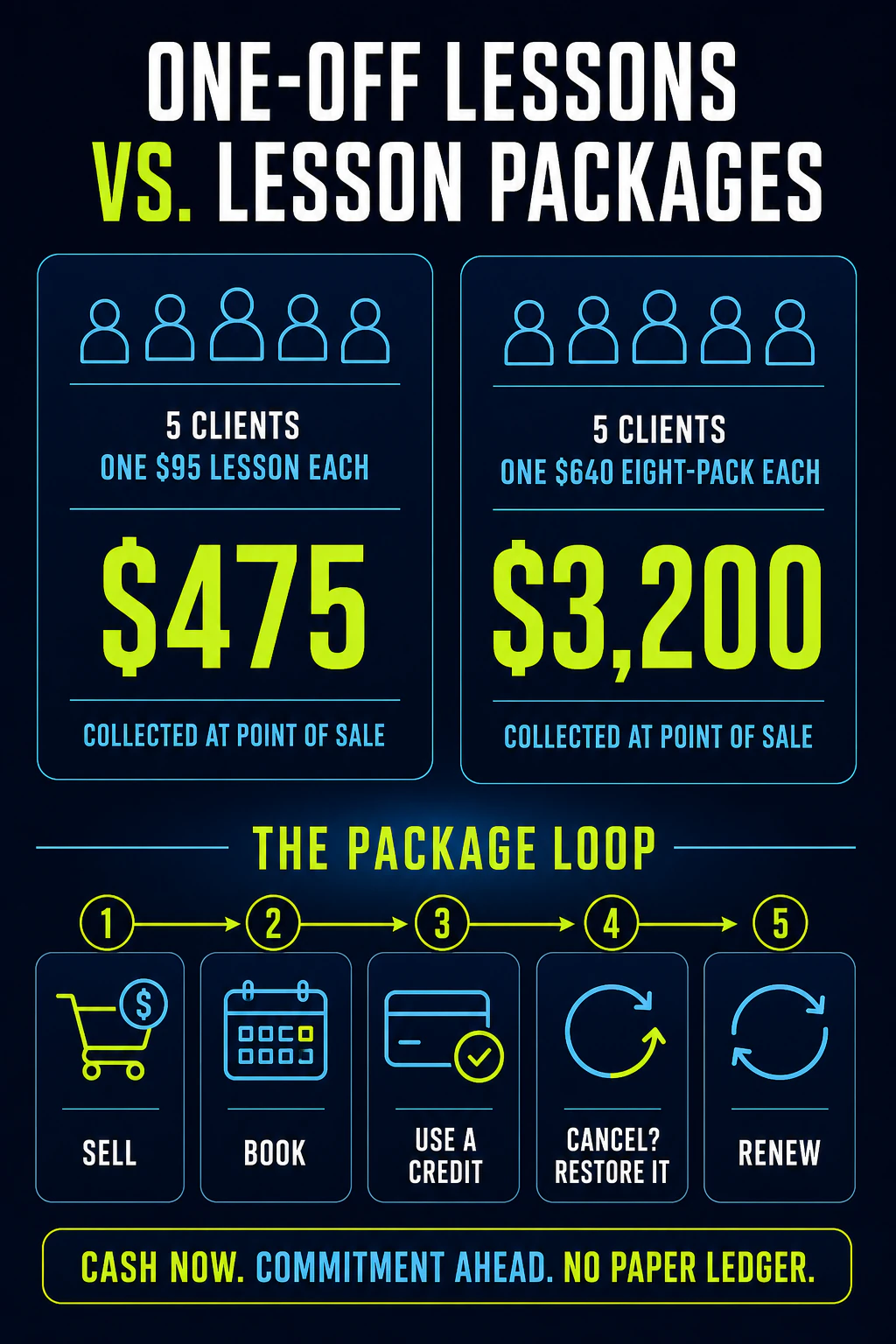
The comparison is about cash collected at the point of sale, not guaranteed profit. The operational advantage comes from carrying each package credit through booking, cancellation, restoration, and renewal without a paper ledger.
Then the paper ledger starts
Packages are easy to sell on day one.
The administration becomes a nightmare on day two.
A coach writes “Sarah: 8 lessons” in a notebook. Sarah books twice, so the coach crosses out 8 and writes 6. One lesson gets rained out. Did that one count? Sarah reschedules another lesson through text. Her spouse books a session for their child. The coach accepts a late cancellation once, but not the next time. Three weeks later Sarah asks, “How many lessons do I have left?”
Now the coach has to reconstruct the answer.
"How many lessons do I have left?" should be a two-second lookup, not a forensic accounting exercise.
The same mess happens in spreadsheets:
- Was the balance updated after the last lesson?
- Did the canceled lesson get added back?
- Is the package attached to the parent or the player?
- Which package does this booking qualify for?
- Did someone accidentally deduct the same credit twice?
- When does the package expire?
- Which clients are close to renewing?
Every package creates a small ledger. Every booking changes that ledger. Every cancellation, reschedule, exception, family member, or manual adjustment creates another chance for the paper record and the real schedule to disagree.
At that point, the package is still producing revenue, but it is also producing unpaid bookkeeping work.
What automatic package administration looks like
The package balance should live with the client and the booking, not in the coach’s memory.
Here is the real Elite Coach Booking production widget using a synthetic test client with package credits on file:
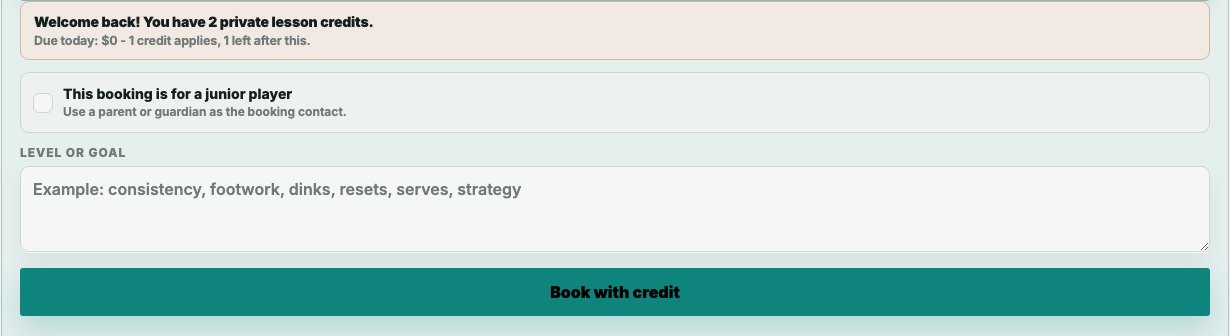
The widget recognizes the eligible package, previews the balance after booking, and changes the action to Book with credit. No paper ledger or promo code is required.
The important part is not just the green button. It is everything the system has already worked out before the client presses it:
- The returning client is matched to their account.
- The selected lesson is checked against their package credits.
- The widget shows that one credit will apply.
- The amount due today changes to $0.
- The client sees how many credits will remain.
- The booking uses the credit and updates the balance.
The client does not need a coupon code. The coach does not need to check a notebook. Nobody has to send a text asking whether the package is still valid.
What happens when a credit-paid lesson is canceled
Cancellations are where manual package tracking usually breaks.
If a client books with a package credit and that lesson has to be canceled, Elite Coach Booking returns the used package credit to the client’s account. The lesson history and the package history stay connected, so the balance is not dependent on the coach remembering to add one back later.
That is the difference between recording a package and administering one.
The system is not merely displaying a number. It is carrying the value through the booking lifecycle:
- Purchase creates the package balance.
- Booking uses an eligible credit.
- The client sees what remains.
- Cancellation returns the used credit.
- The next booking can use that credit again.
- The coach can see the balance and history from the client record.
How to price packages without giving away too much
A package should be attractive, but it still has to be profitable.
Start with the normal one-off price, then decide what the commitment is worth to the business.
A practical package ladder might include:
- One session at the full flexible rate.
- Four sessions at a modestly better per-session rate.
- Eight sessions at the best per-session rate.
Before publishing the prices, check that each package still covers:
- Coaching time.
- Court, field, cage, facility, or travel costs.
- Payment fees.
- Any assistant or staff cost.
- The level of service promised between lessons.
- The risk created by a long redemption window.
The discount should buy something valuable for the coach: cash now, a longer client commitment, a more predictable schedule, or all three.
Set the rules before selling the package
Good package operations also need clear rules.
Decide:
- Which lesson types the credits can be used for.
- Whether credits expire.
- Whether credits can be shared within a family.
- What happens after a late cancellation or no-show.
- Whether unused credits can be refunded or transferred.
- How far ahead clients can book.
The software should carry the balance, but the coach still owns the policy.
Clear rules protect the coach and make the package easier for the client to understand.
The operating value goes beyond the first payment
Upfront cash is the most visible benefit, but it is not the only one.
Packages also reduce the number of separate purchase decisions inside the block and keep the remaining balance visible. Those mechanics do not guarantee that a client books every credit, renews, or produces more revenue.
A package system can carry this loop:
- A client commits to a block of coaching.
- The client can book an eligible lesson against value that is already available.
- The coach can plan the booked sessions as a connected block.
- The remaining balance stays visible.
- A low balance gives the coach a clear point to discuss renewal.
The package remains a prepaid balance with clear rules. Any retention, cash-flow, or coaching benefit depends on what the client books and what the coach delivers.
When the same client trains at the same time most weeks, the guide to running recurring private lessons shows how to turn that package balance into a standing schedule without rebuilding the calendar.
Sell the commitment, not the paperwork
Coaches should be able to sell four or eight lessons without volunteering to become a part-time bookkeeper.
The package should collect payment up front. The client should be able to book against it. The balance should update itself. A canceled credit-paid lesson should put the credit back. The coach should be able to see what happened without comparing a calendar to a notepad.
That is what packages and credits in Elite Coach Booking are built to do.
The coach chooses the offer, the price, and the policy. The system carries the ledger.
Not ready to build yet? Pick the step that fits.
Each one stands on its own. Start small or go straight to a preview of your own site.
- Get a free template Checklists, worksheets, and scripts for coaches. Free to read on the page, with nothing to unlock.
- See six real coach websites Real sports coaching websites connected to programs, scheduling, booking, payments, and daily operations.
- Preview my coaching website Enter a few details and get a live preview with your offers, your booking flow, and your name on it.
- Book a 15-minute call Ask your questions before you buy. Bring your schedule, your offers, and how you take payment today.